Best WSET Level 2 Study Tips: 7 Hacks to Cut Your Study Time in Half
7 proven WSET Level 2 study hacks using spaced repetition, flavor families, and active recall to pass with less time and better retention.
Are you looking for the best WSET Level 2 study tips? You’re probably three weeks from your exam. You’ve read the study materials twice. You’ve highlighted entire pages about Burgundy. You’ve marked up Rioja’s aging rules. You’ve noted the differences between Barolo and Barbaresco. But when you test yourself, you draw a blank. Which DOCGs are in Tuscany? Which are in Piedmont? Is Sancerre in the Loire or Burgundy? The answers escape you.
The problem isn’t lack of study time. It’s the wrong method. Level 2 needs a different approach. The best WSET Level 2 study tips focus on efficiency, not hours logged.
Level 2 is a volume problem. You’re memorizing dozens of wine regions. Each has multiple PDOs (Protected Designations of Origin). Each has grape varieties, climate types, and style traits. Reading and re-reading creates the illusion of learning. But it doesn’t build rapid recall. You need that recall on exam day.
The best WSET Level 2 study tips address this challenge. They move information from recognition to active recall. Recognition means seeing it and thinking “oh yeah, I remember that.” Active recall means producing the answer from memory. No prompts needed. The seven hacks in this article focus on high-efficiency techniques. They cut your study time roughly in half. They improve your retention. Most students spend 45-60 hours preparing for Level 2. Nearly half that time is wasted. Passive reading doesn’t work. Implementing the best WSET Level 2 study tips means working smarter, not longer.
Here’s what no one tells you: students who pass with Distinction don’t study more hours. They use spaced repetition for geography. They group grapes by flavor profiles. They don’t memorize each grape individually. They practice active recall instead of highlighting. These aren’t theoretical study tips. They’re specific techniques that address Level 2’s core difficulty.
Best WSET Level 2 Study Tips: Hack 1 - Use Spaced Repetition for PDO Memorization
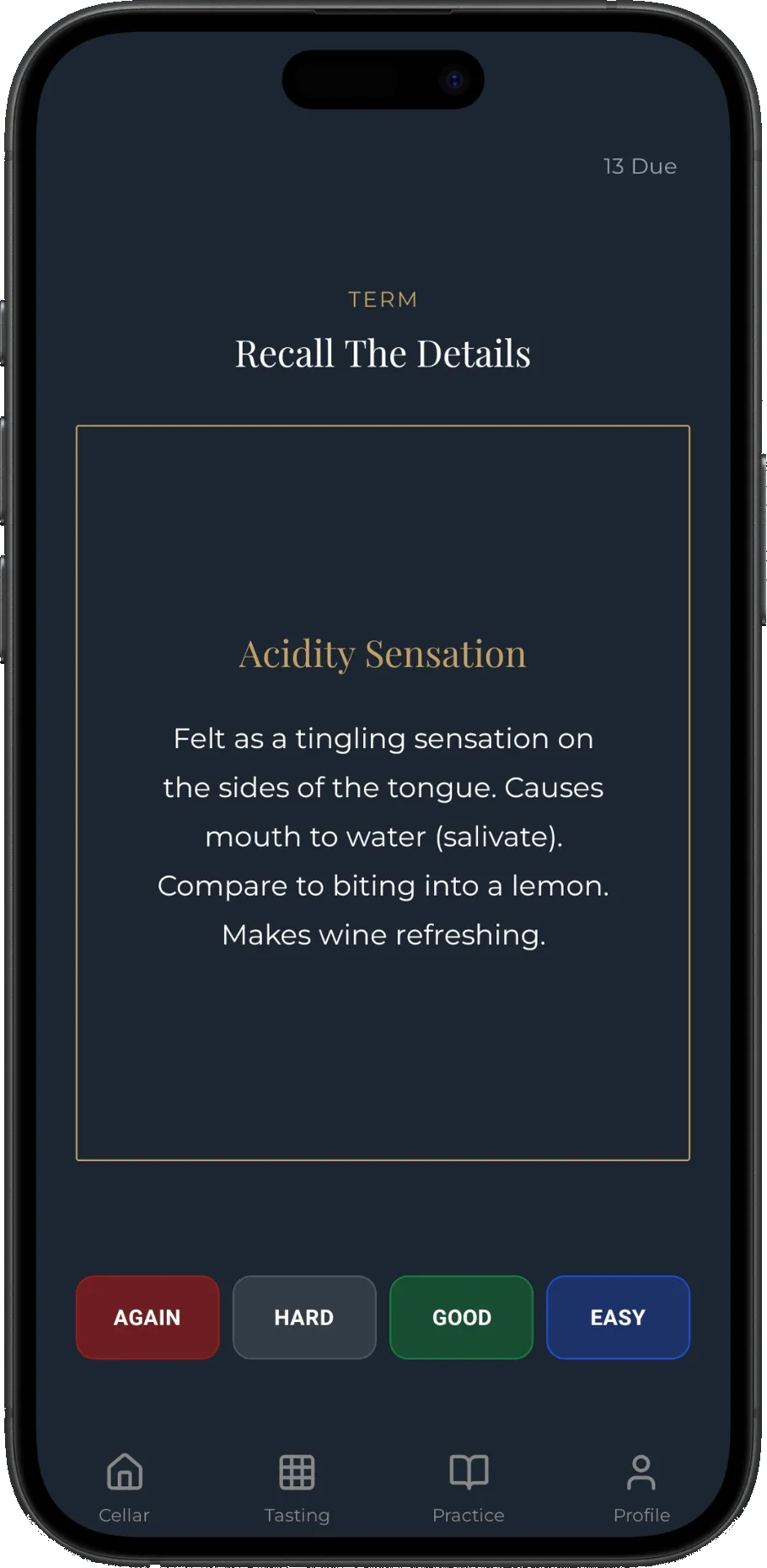
Spaced repetition is the highest-value technique for Level 2 geography. It tops most lists of the best WSET Level 2 study tips. Don’t cram all the Burgundy appellations in one session. Instead, review them at increasing intervals. Day 1, day 3, day 7, day 14, day 28.
This matches how memory works. Your brain strengthens pathways each time you recall information. The best time? Just as you’re about to forget it. Reviewing too soon wastes time. Reviewing too late means you’ve forgotten. Then you relearn from scratch.
For Level 2, create flashcards for each major PDO. Include the region, country, primary grapes, and key style notes. Use a digital tool like Anki. Or use physical cards with a Leitner box system. Study new cards daily. Let the spacing algorithm handle review timing. Cards you know well appear less frequently. Problem areas come up more often.
We’ve seen dramatic improvement in geography retention within two weeks of students switching to spaced repetition. The technique works especially well for memorizing wine regions because it forces active recall rather than passive recognition.
The Specific Schedule That Works for Level 2
Here’s the exact timeline for a typical 6-week Level 2 study period:
Week 1: Introduce all major PDOs as new cards. Study 10-15 new cards daily. Review cards due that day (none initially).
Week 2: Stop adding new cards. Focus entirely on reviewing cards that come due. You’ll see most cards 2-3 times this week as the algorithm spaces them out.
Week 3-4: Continue daily reviews. Cards you know well now appear every 4-7 days. Problem cards (Chablis vs. Côte de Beaune, Barolo vs. Barbaresco) show up more frequently until you get them right consistently.
Week 5: Most cards now appear every 7-14 days. Your daily review load drops to 15-20 minutes instead of 45 minutes in Week 2.
Week 6 (exam week): Final reviews of any remaining problem cards. Don’t cram new information, trust the spacing.
The system works because you’re reviewing Bordeaux appellations five times over six weeks, not once the night before the exam.
Hack 2: Group Grape Varieties by Flavor Profile Families
Most students try to memorize each grape variety as a separate entity: Sauvignon Blanc is this, Chenin Blanc is that, Albariño is something else entirely. That’s 30+ individual memorization tasks. The best WSET Level 2 study tips recommend a smarter grouping approach instead.
Here’s the shortcut: Level 2 grapes cluster into five flavor profile families. Once you recognize the family pattern, you can answer both theory questions and narrow down blind tasting options in seconds.
The Five Flavor Families That Cover 90% of Level 2 Grapes
Crisp & Citrus-Driven Whites: Sauvignon Blanc, Albariño, Grüner Veltliner, Muscadet. High acid, green fruit, minimal oak.
Rich & Textured Whites: Chardonnay (oaked), Viognier, White Rioja (oaked). Fuller body, stone fruit, often creamy.
Aromatic Whites: Riesling, Gewürztraminer, Muscat. Floral, perfumed, ranging from bone-dry to sweet.
Light & Red Fruit Reds: Pinot Noir, Gamay, basic Sangiovese. Lighter body, red cherry and strawberry, moderate tannin.
Structured & Dark Fruit Reds: Cabernet Sauvignon, Syrah/Shiraz, Nebbiolo, Tempranillo. Fuller body, black fruit, firm tannins.
When an exam question asks about “a white wine with pronounced floral aromas and residual sugar,” you’re looking at the aromatic family, probably Riesling or Gewürztraminer. You’ve just eliminated 25 other grapes without individual memorization.
The same logic applies to blind tasting. If you’re identifying black fruit, high tannin, and full body, you’re working within the structured red family. That narrows your SAT grid to four or five grapes instead of scanning the entire variety list. This pattern recognition becomes automatic after tasting just two wines per family, far faster than the traditional grape-by-grape approach most students waste weeks on.
Hack 3: Focus on the ‘Big 6’ Regions
Not all wine regions carry equal weight on the Level 2 exam. Six regions generate the majority of exam questions: Bordeaux, Burgundy, Rhône, Tuscany, Rioja, and Napa Valley. These appear in multiple-choice questions, short-answer prompts, and tasting scenarios far more frequently than smaller appellations.
Allocate your study time proportionally. Spend 60% of your region study on these six, 30% on secondary regions (Mosel, Barossa, Marlborough, Alsace), and 10% skimming the rest. Most students make the mistake of treating all 40+ regions equally, spending the same time on Vinho Verde as they do on Bordeaux. That’s inefficient.
For each of the Big 6, memorize the primary grapes, key appellations, and one defining style characteristic. Bordeaux: Cabernet and Merlot blends, Left Bank vs. Right Bank, structured reds. Burgundy: Pinot Noir and Chardonnay, village-level appellations, terroir-driven. You don’t need every sub-region, just the high-frequency facts that appear on 80% of exam questions about that area.
Hack 4: Build Your Personal Flavor Anchor Library
Most students taste 30+ different wines once and remember nothing by exam day. The more effective approach: taste the same 3-5 anchor wines repeatedly until their flavor profiles become automatic reference points for the SAT.
Choose one wine from each flavor family you identified in Hack 2. A classic Marlborough Sauvignon Blanc for high-acid herbaceous whites. An oaked California Chardonnay for full-bodied whites. A Chianti Classico for medium-bodied, high-tannin reds. These become your calibration standards, the flavors you compare everything else against during the blind tasting exam.
Taste each anchor wine at least three times over your study period, taking SAT-style notes each time. By the third tasting, you’ll recognize the profile instantly and can describe it in exam language without hesitation.
Which Wines to Choose as Your Anchors
Pick widely available, affordable bottles you can rebuy if needed. Avoid expensive or rare wines, you need consistency, not prestige. A $15-20 bottle works perfectly as an anchor. Look for wines that clearly express their variety and region: Kim Crawford Sauvignon Blanc, Kendall-Jackson Chardonnay, Antinori Chianti Classico. These are textbook examples that match what examiners expect you to recognize.
Budget substitutions: If $15-20 per bottle adds up too quickly, buy half-bottles (375ml) or split full bottles with study partners. You only need 2-3 ounces per tasting session. Trader Joe’s and Costco carry solid varietal examples for $8-12 that work fine, just verify the label clearly states the grape and region.
Avoid “interesting” or atypical wines for anchors. That natural wine Sauvignon Blanc or that orange-wine Pinot Grigio won’t help you on exam day. You’re building a mental library of standard expressions, the baseline profiles examiners test against. Once you pass, drink whatever you want.
Hack 5: Replace Passive Reading with Active Recall
Highlighting your course book feels productive. It’s not. Re-reading the same chapter on Bordeaux three times doesn’t move information into long-term memory, it just makes the page look familiar. Most WSET Level 2 students waste 40-50% of their study time on passive review that produces minimal retention.
Active recall forces your brain to retrieve information without prompts. Close the book. Write down everything you remember about Right Bank Bordeaux. Check your answer. Repeat with what you missed. This method feels harder because it is harder, and that difficulty is exactly what builds durable memory. Among the best WSET Level 2 study tips, active recall delivers the highest return on time invested.
The most effective active recall tool for Level 2 is the blank map method. Print outline maps of major wine regions (Bordeaux, Burgundy, Northern Rhône, Piedmont). Without looking at your notes, label appellations, rivers, major towns, and key grape varieties. Check your work. Mark what you missed in red. Two days later, do it again with a fresh blank map.
You’ll remember more from 15 minutes of blank map practice than from an hour of highlighting.
The Blank Map Method for Geography Questions
Download blank outline maps from Wine Folly’s free map library or the Guild of Sommeliers resource section. Print three copies of each major region, Bordeaux, Burgundy, Northern Rhône, Tuscany, and Rioja cover most Level 2 geography questions.
Practice schedule: Fill out one blank map every other day during your first three weeks of study. In week four, switch to filling out all five maps in one session twice per week. This spacing pattern matches how the exam tests geography, not as isolated questions, but mixed throughout the paper.
Start with the easiest layer: major subregions and rivers. Bordeaux first session: label Left Bank, Right Bank, Médoc, Graves, Dordogne River, Garonne River. Second session: add Haut-Médoc, Pauillac, Margaux, Saint-Émilion, Pomerol. Third session: add grape varieties to each area.
Time yourself. Your first attempt might take 12 minutes. By your sixth repetition, you should complete the same map in under 4 minutes with 90%+ accuracy. That speed improvement is the clearest signal that information has moved from short-term recognition to retrieval-ready memory.
Hack 6: Create a One-Page Correlation Cheat Sheet
Level 2 doesn’t test whether you can recite that Chablis is in Burgundy. It tests whether you understand why Chablis tastes different from Meursault, same grape, different climate and winemaking choices.
Your cheat sheet should map these cause-and-effect relationships on a single page. Create three columns: Climate (cool/moderate/warm), Common Techniques (oak/no oak, malolactic/blocked MLF, lees aging), and Resulting Style (high acid/low acid, fruit-forward/mineral, full-bodied/light-bodied).
Fill it in by grape variety first. Chardonnay row: cool climate → no oak, no MLF → lean, high acid, green fruit (Chablis). Moderate climate → oak, full MLF, lees aging → creamy, medium acid, stone fruit (Meursault). Warm climate → oak, full MLF → full-bodied, low acid, tropical fruit (California).
This format makes exam questions transparent. When a question describes “a Chardonnay with high acidity, green apple notes, and no oak,” you’re not guessing regions, you’re following the correlation back to cool climate, which points to Chablis or Mâconnais.
What to Include on Your Cheat Sheet
Focus on the grapes that appear in multiple regions with style variations: Chardonnay, Pinot Noir, Cabernet Sauvignon, Syrah/Shiraz, and Riesling. These five account for most correlation questions on the exam.
For each grape, capture three data points: climate category (cool/moderate/warm), key technique (the one winemaking choice that most defines the style, oak, MLF, lees aging, carbonic maceration), and flavor profile shorthand (two or three descriptor words maximum).
Add a fourth column for example PDO, just one representative region per climate/style combination. You’re not memorizing every PDO; you’re building mental anchors. Chablis for unoaked cool-climate Chardonnay. Barolo for high-tannin Nebbiolo. Marlborough for high-acid Sauvignon Blanc.
Keep it to one side of standard paper. If you need a second page, you’re including too much detail. The cheat sheet works because it forces prioritization, you can’t fit everything, so you capture only the correlations that repeat across exam questions. Use abbreviations ruthlessly: “hi acid” instead of “high acidity,” “trop frt” instead of “tropical fruit.”
Review this sheet for five minutes before practice questions and again the night before your exam.
Hack 7: Use the 80/20 Rule for Tasting Practice
Most students waste tasting practice time chasing perfect aroma identification, trying to distinguish between “lemon” and “lime” or debating whether that note is blackcurrant or blackberry. Here’s what actually matters for Level 2: intensity assessment, structural balance, and climate conclusions.
The exam doesn’t test your ability to name twelve specific aromas. It tests whether you can identify a wine as high-intensity versus medium, determine if it’s from a cool or warm climate based on fruit character, and assess structural elements like acidity and tannin levels. These three skill areas produce the majority of your SAT marks.
Focus 80% of your tasting practice on these high-value skills: judging whether acidity is low/medium/high (not naming the specific fruit), assessing body and alcohol level, and determining tannin intensity and texture in reds. Practice the structural triangle, acid, tannin, alcohol, until you can rank them reliably.
The remaining 20% goes to aroma families (citrus versus stone fruit versus tropical), not specific descriptors. You need broad categories for the aroma wheel, not precision. “Stone fruit” earns the same marks as “peach.”
When time is limited, skip the deep aroma work. Nail structure first, add fruit family categories second, worry about specific descriptors never. This prioritization approach reflects what the best WSET Level 2 study tips consistently emphasize: focus on what earns marks, not what feels impressive.
Put it into practice
Drill every grape and region from this guide.
VinoPrep's flashcards, interactive maps, and exam simulator are built to help you apply exactly what you've just learned.