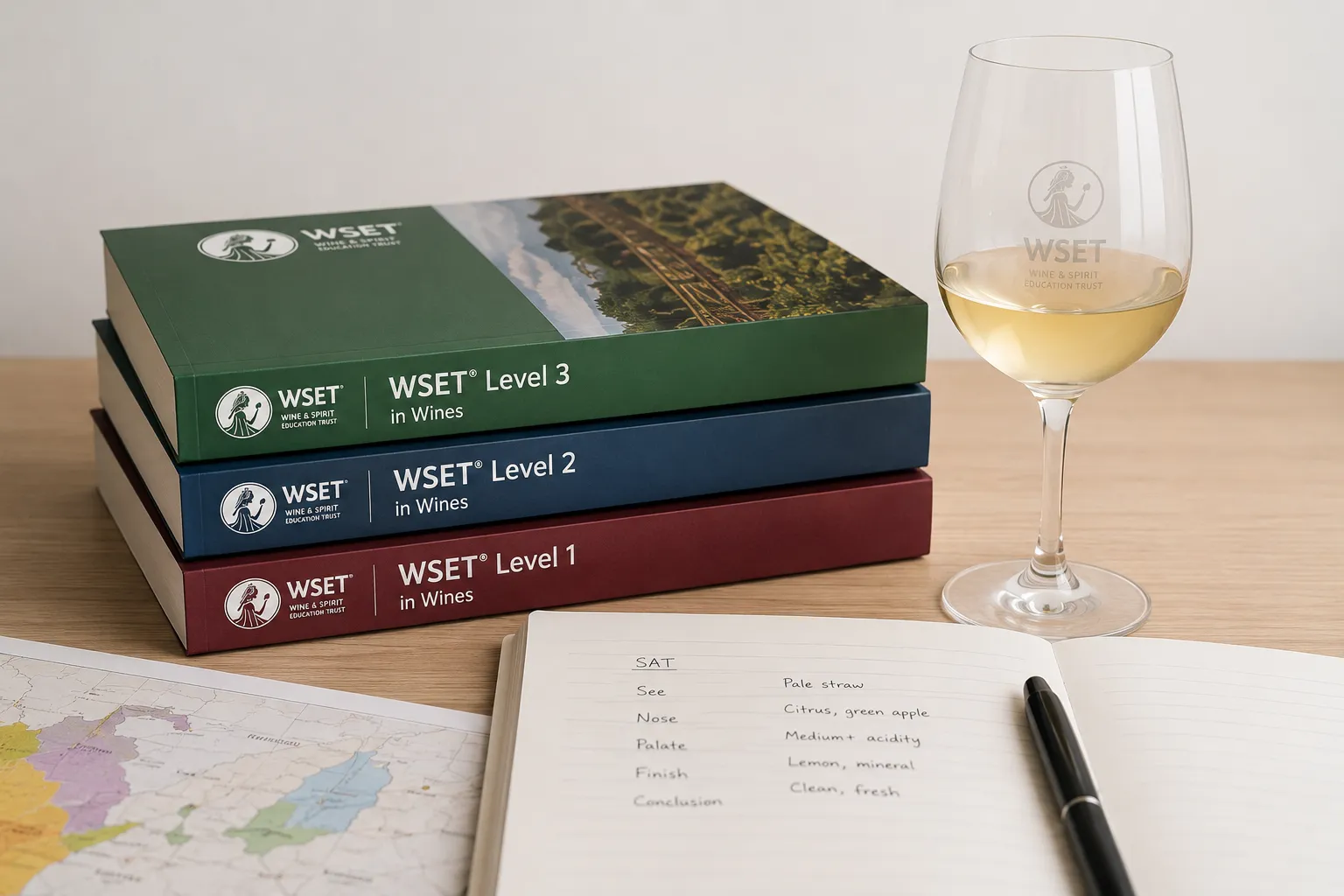
Is WSET Actually Worth the Money?
Type “WSET” into any wine forum and you’ll find the same debate repeated endlessly: “Is it actually worth the money?”
It’s a fair question. Between course fees, exams, study materials, and practice wines, a serious WSET journey from Level 2 through Level 3 can easily cost $1,500-$3,000. That’s real money, and “I learned a lot” isn’t always a satisfying return on investment.
The honest answer depends on what you want from it. In some situations, a WSET certification is one of the best investments you can make in a wine career. In others, it’s genuinely not worth it, and we’ll tell you exactly when that’s the case.
After helping hundreds of WSET students prepare with the VinoPrep app, we’ve seen a clear pattern in who gets the most out of these wine certifications.
The Quick Answer, by Profile
| Your Situation | Is WSET Worth It? | Recommended Level |
|---|---|---|
| Curious enthusiast | Yes, for structure and confidence | Level 1 or 2 |
| Hospitality professional | Yes, widely expected | Level 2, then 3 |
| Wine retail / sales | Yes, strong hiring signal | Level 2, then 3 |
| Career changer into wine | Yes, fastest credibility builder | Level 2 → 3 |
| Aspiring sommelier (floor service) | Partially, consider CMS too | Level 3 + CMS comparison |
| Already senior in the trade | Only for Diploma-level goals | Level 4 (Diploma) |
If you want the detailed reasoning behind each of these answers, keep reading.
What You’re Actually Buying
Before judging the value, it helps to be precise about what a WSET certification actually delivers. There are three distinct assets:
1. Globally Recognized Proof of Knowledge
The Wine & Spirit Education Trust is the largest global provider of wine qualifications, delivered through approved programme providers worldwide. When a hiring manager in London, New York, or Singapore sees “WSET Level 3” on a CV, they know exactly what it means: this person has passed a standardized, externally assessed exam covering the world of wine.
That standardization is the core value. Anyone can claim to “know wine,” but a formal qualification removes the doubt.
2. A Structured Knowledge System
Self-taught wine knowledge tends to be patchy: deep on the regions you love, blank on everything else. WSET forces you through a complete, logically ordered curriculum, from viticulture and winemaking to every major region and style. Students consistently tell us the biggest benefit is finally having a mental framework where new wine knowledge has a place to live — more than the certificate itself.
3. The Systematic Approach to Tasting (SAT)
From Level 2 onward, WSET trains you to taste analytically using the SAT. This is a professional skill with daily practical value: writing consistent tasting notes, assessing quality objectively, and communicating about wine in a shared vocabulary. If you work with wine in any capacity, this alone justifies a significant portion of the fee.
The Real Cost (Quick Recap)
We’ve published a complete breakdown of WSET costs, but here’s the short version:
- Level 1: $250-$300, one day
- Level 2: $500-$800, plus 28-30 hours of self-study
- Level 3: $900-$1,500, plus roughly 84 hours of total study time
- Diploma (Level 4): $4,000-$10,000+ over 18 months to 3 years
The hidden costs matter too: practice wines, potential resit fees ($100-$300 per attempt), and your time. When people say “WSET wasn’t worth it,” the story usually involves a failed exam and an expensive resit — which comes down to preparation rather than the qualification itself.
Does WSET Actually Increase Your Salary?
A lot of content online oversells this part, so let’s be precise.
A WSET certificate does not automatically raise your salary. No employer hands out a pay bump because a certificate arrived in the mail. What WSET does is change which rooms you can get into:
- Job listings: Many wine retail, importer, distribution and hospitality job listings now mention WSET Level 2 or 3 as preferred qualifications. Without a WSET certification, your CV may not clear the first filter.
- Promotion cases: In structured companies (importers, national retailers, hotel groups), certifications are concrete evidence in promotion discussions. Level 3 is frequently the informal bar for buyer and supervisor roles.
- Career changes: For people entering wine from another industry, WSET is the fastest way to signal seriousness. It compresses the “prove you’re not a tourist” phase from years to months.
- Freelance credibility: Educators, writers, and consultants use WSET (especially Level 3 and Diploma) as third-party validation when clients have no other way to assess expertise.
The realistic model is this: WSET is a door-opener, not a pay raise. The salary impact comes from the roles it unlocks, and that impact compounds over a career. A Level 3 certificate that helps you land a buyer role two years earlier than otherwise is worth far more than its $1,200 price tag.
Is Each Level Worth It?
WSET Level 1: Worth It for a Specific Person
Level 1 is a pleasant one-day introduction, but it carries little professional weight on its own. It’s worth it if you’re a complete beginner who wants a gentle, confidence-building start, and not worth it if you already know your Cabernet from your Chardonnay. Most motivated learners can skip straight to Level 2.
WSET Level 2: The Best Value in Wine Education
If we had to pick one level with the strongest ROI, it’s Level 2. For $500-$800 you get the complete foundation: major grape varieties, the world’s key regions, production methods, and the SAT. It’s the common entry-level benchmark for wine industry jobs, and most well-prepared candidates pass. For enthusiasts, it’s the level where wine lists and shop shelves suddenly make sense.
Verdict: worth it for almost everyone serious about wine. Our complete Level 2 study guide shows exactly how to pass on the first attempt.
WSET Level 3: The Professional Benchmark
Level 3 is where the investment gets serious, in money, hours, and difficulty. The jump from Level 2 to Level 3 is widely considered the biggest in the WSET pathway, and it introduces written answers and blind tasting.
It’s also where the professional payoff concentrates. Level 3 is the qualification that buyers, head sommeliers, and educators are commonly expected to hold. If wine is (or will be) your career, Level 3 is worth it. If wine is a hobby, Level 3 is only worth it if the challenge itself excites you, because many students spend 6–10 hours per week during the course.
Verdict: worth it for professionals and ambitious enthusiasts. Read our Level 3 exam guide before committing.
WSET Diploma (Level 4): Only for the Committed
The Diploma is a multi-year, several-thousand-dollar commitment aimed at senior trade roles, serious educators, and future Master of Wine candidates. The ROI is real but narrow: don’t start it “to see how it goes.”
When WSET Is NOT Worth It
There are cases where we’d tell you to save your money:
- You want floor-service sommelier skills above all. WSET teaches wine knowledge and analytical tasting, not service. If your dream is the restaurant floor, compare it carefully with the Court of Master Sommeliers first — we’ve written a full WSET vs CMS comparison.
- You expect the certificate alone to get you hired. WSET opens doors, but experience, tasting groups, and industry relationships close deals. A certificate without engagement in the wine world has limited value.
- You just want to enjoy wine more. If you have no interest in structured study or exams, a good local tasting club and curious drinking will serve you well for a fraction of the price. WSET rewards people who like frameworks and goals.
- You’re not willing to prepare properly. Failing Level 3 and paying for resits is the single fastest way to turn a good investment into a bad one.
How to Maximize Your WSET ROI
If you’ve decided to go for it, protect your investment:
- Skip Level 1 if you can. Start at Level 2 and put the savings toward practice wines.
- Pass on the first attempt. A failed exam means months of repeated study on top of the fee. Use active recall and mock exams rather than passive reading — the most common Level 3 mistakes are entirely avoidable.
- Practice tasting deliberately. Use the wine aroma wheel and the SAT on every bottle you open. Free practice, professional skill.
- Use your study time efficiently.
🍷 Stop cramming and start passing.
The VinoPrep app turns your commute or lunch break into high-yield study time with exam-style quizzes, flashcards, wine maps and mock exams.
Download VinoPrep on iOS | Download VinoPrep on Android
Can You Work in Wine Without WSET?
Yes. Plenty of successful wine professionals never sat a WSET exam. For people entering the industry today, though, a WSET certificate has become one of the quickest ways to demonstrate foundational knowledge and stand out in a competitive job market. It complements experience rather than replacing it.
Key Takeaways
Is WSET worth it? For most people reading this: yes, with conditions.
- Level 2 is the best-value entry point — a complete foundation, an industry hiring benchmark, and a high pass rate with proper preparation.
- Level 3 is worth it if wine is your career (or you want a serious intellectual challenge). It’s the qualification the trade actually looks for.
- Don’t expect an automatic raise. The value comes from the roles WSET unlocks and the credibility it builds, which compound over years.
- It’s not worth it if you want pure service training, expect the paper alone to get you hired, or won’t commit to real preparation.
The certificate is only half the equation. The other half is passing efficiently, on the first try, with knowledge that actually sticks. That’s the part you control, and it’s exactly what VinoPrep was built for.
Frequently Asked Questions
Is WSET worth it if I don’t work in the wine industry?
Yes, if you enjoy structured learning. Level 2 transforms how you buy, taste, and talk about wine. If you dislike exams and formal study, informal tastings may serve you better.
Which WSET level is most worth the money?
Level 2 offers the strongest value for most people: a complete foundation and an industry hiring benchmark for $500-$800. Level 3 delivers the biggest career payoff for wine professionals.
Will WSET get me a job in wine?
WSET gets you interviews, not jobs. It’s an increasingly common filter on wine retail, distribution, and hospitality job listings, but employers still hire for experience, attitude, and tasting ability.
Is WSET worth it compared to becoming a sommelier through CMS?
They serve different goals: WSET builds deep, examinable wine knowledge; CMS emphasizes restaurant service. Many professionals do both. See our full WSET vs CMS comparison for details.
How can I make sure my WSET investment pays off?
Pass on the first attempt. Budget realistic study hours, use active recall tools like flashcards and mock exams, and practice the SAT regularly. Resit fees and repeated study cycles are the main way students lose money on WSET.
Ready to put this into practice?
VinoPrep's flashcards, interactive maps, and exam simulator are built to help you apply exactly what you've just learned.