Portugal
Port Wine Styles Explained: Ruby to Tawny for WSET
Port wine styles explained for WSET: Douro grapes, fortification, Ruby vs Tawny, LBV vs Vintage, age-indicated Tawny and what Levels 2 and 3 expect.
Ruby, Tawny, LBV, Vintage: Why Port Labels Feel Like a Code
You open a mock exam, and the question asks which Port is aged in small oak casks and tastes of walnuts and caramel. Or which one is bottled after four to six years and is ready to drink. Suddenly every Port style on the shelf looks the same: sweet, red and strong.
Here’s the reassuring part. Port wine styles follow one simple logic, and once you see it, the labels decode themselves. Every Port starts the same way, as a sweet, fortified red wine. What separates a fruity Ruby from a nutty 20 Year Old Tawny is how long it ages, and in what kind of vessel. This guide explains Port the way WSET teaches it, from the Douro vineyards to the exam paper.
Where Port Sits in the WSET Syllabus
Port appears at Level 2 and again, in more depth, at Level 3. Here’s what the official specifications expect (Level 2 Issue 2.1, 2026, and Level 3 Issue 2, 2022):
| Level | What you need to know | How much it’s worth |
|---|---|---|
| Level 2 | Port is fortified to stop fermentation, then aged. Label terms: Ruby, Reserve Ruby, LBV, Vintage and Tawny | Sparkling and fortified wines together: 6 of 50 multiple-choice questions |
| Level 3 | The five main grapes, extraction methods, fortification, maturation (short or long, wood or inert), and the styles Ruby (Reserve), Tawny (Reserve), LBV, Vintage and Tawny with an Indication of Age | Fortified wines: 5 of 50 multiple-choice marks, plus a 20-mark written slot shared with sparkling wines |
Port also shows up in the recommended tasting samples. The Level 2 specification suggests an LBV or Tawny, and the Level 3 specification lists an LBV or Vintage Port and an age-indicated Tawny as essential samples. The Level 3 tasting exam itself uses still wines only, so you’ll taste Port in class rather than in the exam.
WSET updates its specifications from time to time, so always check the latest version with your course provider.
Where Port Comes From: The Douro Valley
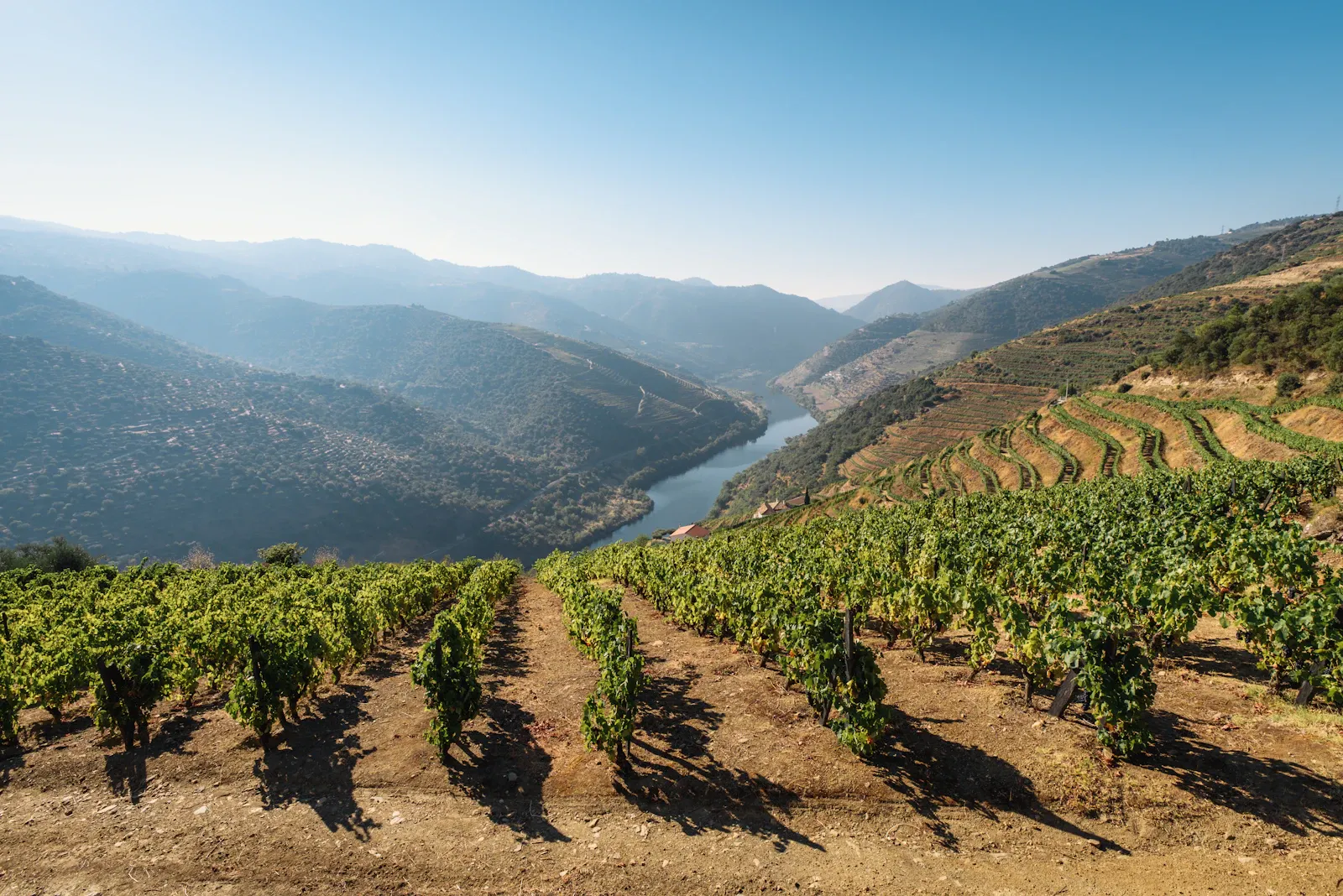
Port is made from grapes grown in the Douro Valley in northern Portugal. The river cuts through steep hills of schist, a rock that splits into vertical layers. The soils are thin and poor, but vine roots can push down through the cracks to find water deep below, which matters a lot in such a hot, dry place. Most vineyards sit on terraces carved into the slopes, which is why so much of the work is still done by hand.
The valley is usually split into three subregions, and they get hotter and drier as you travel inland, away from the Atlantic:
| Subregion | Climate | Typical role |
|---|---|---|
| Baixo Corgo | Coolest and wettest (about 900 mm of rain a year) | Mostly early-drinking Ruby and inexpensive Tawny |
| Cima Corgo | Hotter and drier (about 700 mm) | The heart of Vintage and age-indicated Tawny production |
| Douro Superior | Hottest and driest (about 450 mm), summers can reach 40 °C | Heat-tolerant varieties such as Touriga Franca and Touriga Nacional do well here |
You won’t need the rainfall figures for the exam, but the pattern helps you explain why the Douro gives such ripe, concentrated grapes.
The Grapes: Five Names to Know
Port is almost always a blend. The Level 3 specification names five black grape varieties:
- Touriga Nacional: deep color, intense black fruit and floral aromas, and firm tannins. Often seen as the quality star.
- Touriga Franca: floral and fruity, and it copes well with heat.
- Tinta Roriz: the local name for Tempranillo, adding red fruit and body.
- Tinta Barroca and Tinto Cão: useful blending partners that add fruit, color or structure.
A classic multiple-choice trap is a list of four grapes where one doesn’t belong. If you see a white grape such as Ugni Blanc next to the Tourigas, that’s your odd one out.
How Port Is Made: Fast Extraction, Then Fortification
The key to Port is that fermentation is stopped early by adding grape spirit. The spirit used is a neutral grape spirit, called aguardente in Portugal, at 77% abv. It raises the alcohol so high that the yeast can no longer work, so a large amount of the grapes’ natural sugar stays in the wine. The finished Port is sweet and usually between 19% and 22% abv.
That creates a problem: fermentation is very short, so there’s little time to pull color and tannin out of the skins. Port producers solve this with vigorous extraction:
- Foot treading in shallow stone tanks called lagares, still considered a benchmark for top wines
- Autovinifiers, which use the pressure of carbon dioxide from fermentation to pump juice over the skins
- Piston plungers and robotic lagares, which push the skins down mechanically
Remember the big contrast with dry Sherry, which we cover in our Sherry styles guide: Port is fortified during fermentation, Sherry after it. Our guide to how sweet wine is made shows where Port fits among the other ways of keeping sugar in a wine.
💡 Tip: For every Port style, ask two questions: “How long?” and “In what?” Short ageing in large vessels keeps the wine fruity and deep in color (Ruby styles). Long ageing in small casks lets oxygen in, turning it nutty and tawny (Tawny styles). Bottle ageing without oxygen gives Vintage Port its slow evolution. Answer those two questions and you can describe almost any Port.
Ruby or Tawny: The Two Families
After fortification, the young wine is matured. Traditionally, Port was shipped downriver to the lodges of Vila Nova de Gaia, opposite the city of Porto, where the cooler, more humid conditions protect the wine from the summer heat of the Douro. Today many wines also age in modern, climate-controlled cellars in the valley.
From here, every Port follows one of two paths:
| Family | How it ages | What it tastes like | Styles |
|---|---|---|---|
| Ruby styles | Short maturation in large vats (wood or inert), or long ageing in bottle, with little oxygen | Deep ruby color, fresh red and black fruit, often firm tannins | Ruby, Reserve Ruby, LBV, Vintage |
| Tawny styles | Long maturation in smaller oak casks, with slow oxidation | Tawny or amber color, dried fruit, nuts, caramel, softer tannins | Tawny, Reserve Tawny, Tawny with an Indication of Age |
Large vessels expose only a small part of the wine to the wood and air, so the fruit stays fresh. Small casks expose much more, which is why Tawny Ports lose their purple color and gain those walnut, toffee and spice notes. If you want a refresher on how vessel size changes oxygen contact, our guide to oak in winemaking covers it in detail.
The Ruby Styles in Detail
Ruby and Reserve Ruby
Ruby is the simplest style: a blend of young wines from different years, aged for a short time and bottled to keep its fresh, fruity character. Reserve Ruby (you may also see “Ruby Reserve”) is a higher-quality blend with more concentration and depth. Both are ready to drink when bottled.
Late Bottled Vintage (LBV)
LBV comes from a single year, but it’s aged longer before bottling than Vintage Port: the official rule is four to six years in wood after the harvest. That extra time softens the wine, so most LBVs are ready to drink on release and offer a taste of the Vintage style at a lower price. Some producers make unfiltered LBVs that keep developing in bottle, so it’s worth checking the label.
Vintage Port
Vintage Port is the top of the Ruby family. It comes from a single, exceptional year and is bottled early, two to three years after the harvest, without filtration. Producers only “declare” a vintage in the best years, and each wine must be approved by the IVDP, the official body that regulates Port.
Because it spends so little time in wood, Vintage Port is powerful, tannic and packed with black fruit when young. It’s built to age in bottle for decades, slowly gaining complexity without the oxidative character of a Tawny. Over time it throws a heavy sediment, so it usually needs decanting. You can test yourself on this with Question 12 in our WSET Level 3 practice questions.
A Single Quinta Vintage Port follows the same rules but comes from one estate (a quinta), often in years that aren’t declared as general vintages. It isn’t in the Level 3 specification, but it’s useful to recognize on a wine list.
The Tawny Styles in Detail
Tawny and Reserve Tawny
A Tawny is a blend of several years aged in wood. Reserve Tawny must spend at least seven years in wood, which gives it a more developed, nutty character than a basic Tawny.
Tawny with an Indication of Age
These are the famous 10, 20, 30 and 40 Year Old Tawnies, and a 50 Year Old category was added in 2021. They’re blends of several vintages, and the age on the label describes the style and character of the blend rather than the exact age of every drop in it. The IVDP tastes and approves each wine before it can carry the term.
As the age goes up, the color fades from tawny to amber, and the flavors move from red fruit and caramel towards dried fruit, walnut, coffee and spice, with a long finish. These wines are ready to drink when bottled and don’t need decanting.
Colheita: a single-vintage Tawny
A Colheita is a Tawny from a single year, aged in wood for at least seven years. Its label shows the harvest year. Colheita isn’t in the Level 3 specification either, but students often confuse it with Vintage Port. The simple rule: Vintage = single year, aged in bottle; Colheita = single year, aged in wood.
White and Rosé Port
Port can also be white or pink. White Port ranges from dry to very sweet, and older examples gain a golden color from oxidative ageing. Rosé Port is made with only light skin contact and is meant to be drunk young and chilled. Neither appears in the Level 3 specification, so treat them as background.
How to Use This in the Exam
In the multiple-choice paper, expect matching questions: which style is bottled after four to six years, which grape doesn’t belong in Port, which style tastes of dried fruit and nuts (the Level 2 sample question asks exactly this about Tawny). The two-family table above answers most of them.
In the written paper, link process to style. A strong answer explains the chain: “Fortification stops fermentation, so the wine keeps natural sweetness and high alcohol. Vigorous extraction gives deep color and tannin. Long ageing in small casks lets oxygen in, so the wine becomes tawny with nutty, dried fruit flavors.”
In class tastings, compare an LBV or Vintage with an age-indicated Tawny side by side. Color alone tells you a lot, and practicing precise descriptions of sweetness, alcohol and tannin also helps your still-wine tasting.
🍷 Want Port styles to stick before exam day?
The VinoPrep app helps you master fortified wines and the rest of the syllabus with WSET-style mock exams, flashcards and interactive wine maps, and shows you which topics still need work.
Download VinoPrep on iOS | Download VinoPrep on Android
Key Takeaways
- Port comes from the Douro Valley in northern Portugal, with schist soils, terraced slopes and a hot, dry climate that gets more extreme inland.
- The key grapes are Touriga Nacional, Touriga Franca, Tinta Roriz, Tinta Barroca and Tinto Cão.
- Fortification with grape spirit stops fermentation, leaving sweetness and 19% to 22% abv, so extraction must be fast and vigorous.
- Ruby styles (Ruby, Reserve Ruby, LBV, Vintage) keep their fruit through short ageing in large vessels or ageing in bottle.
- Tawny styles (Tawny, Reserve Tawny, age-indicated Tawny) gain nutty, dried fruit flavors from long ageing in small oak casks.
Frequently Asked Questions
What are the main Port wine styles?
Port styles fall into two families. Ruby styles (Ruby, Reserve Ruby, Late Bottled Vintage and Vintage) are aged briefly in large vessels or in bottle, so they stay deep in color and fruity. Tawny styles (Tawny, Reserve Tawny and Tawny with an Indication of Age, such as 10 or 20 Year Old) are aged for longer in smaller oak casks, so they turn tawny and develop nutty, dried fruit flavors.
What is the difference between Ruby and Tawny Port?
Ruby Port is matured for a short time in large vessels with little oxygen contact, so it keeps a deep ruby color and fresh red and black fruit. Tawny Port is matured for longer in smaller oak casks, where slow oxidation turns the color tawny and adds flavors of walnut, caramel and dried fruit. Both are sweet and fortified.
What is the difference between LBV and Vintage Port?
Both come from a single year. Vintage Port is made only in the best declared years and is bottled two to three years after the harvest without filtration, then ages in bottle for decades and usually needs decanting. Late Bottled Vintage is aged four to six years in wood before bottling, so it is softer and usually ready to drink on release.
What does the age on a 20 Year Old Tawny mean?
A 20 Year Old Tawny is a blend of wines from several years. The age describes the style and character of the blend, approved by the IVDP, rather than the exact age of every wine in it. Age-indicated Tawnies come in 10, 20, 30, 40 and, since 2021, 50 Year Old categories.
Which Port styles do I need to know for WSET Level 3?
The Level 3 specification lists Ruby (Reserve), Tawny (Reserve), Late Bottled Vintage, Vintage and Tawny with an Indication of Age. You also need to know the grapes Touriga Nacional, Touriga Franca, Tinta Roriz, Tinta Barroca and Tinto Cão, the extraction methods (foot treading, autovinifiers and piston plungers), fortification to stop fermentation, and how short or long maturation in wood or inert vessels shapes each style.
Put it into practice
Drill every grape and region from this guide.
VinoPrep's flashcards, interactive maps, and exam simulator are built to help you apply exactly what you've just learned.